The NAS100 (or US100) is the most traded index on prop firm trading accounts: its volatility offers real opportunities, but it quickly disqualifies traders who approach it without a method. A prop firm indices training course serves exactly that purpose: not just "following the movement," but building a trading plan consistent with the rules of a challenge — daily drawdown, profit target, consistency. Here is what a good program should cover in 2026, supported by a comparison of the indices.
Why the NAS100 fascinates (and traps) prop firm traders
The NAS100 brings together the 100 largest non-financial stocks on the Nasdaq, with a very heavy weighting on technology (Apple, Microsoft, Nvidia, among others). A direct consequence: the index reacts violently to US economic publications, corporate earnings, and Federal Reserve announcements. During a single session, it is not uncommon to see ranges of 150 to 300 points.
For a prop firm candidate, this range is a double-edged sword. It allows you to reach an 8 to 10% target faster than in Forex, but it also magnifies every management error. This is why training dedicated to indices is not a luxury: the value of a point, the rhythm of US news, and exit discipline must become reflexes before launching any challenge.
What a prop firm indices training must actually cover
1. Understanding the logic of the index
A serious program begins with the mechanics of the NAS100: its composition, its weighting, and the fact that a handful of stocks can move the entire index. You learn to read an economic calendar (CPI, FOMC, NFP) and to anticipate windows of high volatility rather than being subjected to them.
2. Mastering the schedule and phases of the session
The NAS100 follows the US session: the New York open at 3:30 PM (Paris time) is the most active moment, often preceded by a lull during the European lunch. Good training breaks the day down into phases — pre-open, open, mid-session, final 30 minutes — and tells you which ones suit your style. This is exactly the reflection conducted in our article on scalping and swing trading in prop firms, applied here to indices.
3. Applying appropriate risk management
Indices are traded in points, and the value of a point depends on position size. If you come from Forex, this is a complete change of perspective. The training must make you work on: position size calculated before entry, risk limited to 0.5% or 1% per trade, stopping for the day if 50% of the daily drawdown is hit, and keeping a trading journal every evening. Without this foundation, the volatility of the NAS100 erodes an account in just a few sessions.
Comparison: which index should you target in a prop firm?
| Index | Other name | Venue | Volatility | Recommended level |
|---|---|---|---|---|
| NAS100 | US100 / Nasdaq 100 | Nasdaq (New York) | Very high | Intermediate, with strict risk rules |
| US30 | Dow Jones / DJ30 | New York | High, sharp moves | Advanced |
| US500 | S&P 500 / SPX500 | CME (Chicago) | Moderate to high | Good balance for progress |
| DAX40 | GER40 | Frankfurt | High, sensitive to US news | Intermediate |
The NAS100 remains the most formative index for a challenge: regular, highly liquid, and documented everywhere. Many traders combine it with the DAX40 to cover the European-American open.
The 4-week sample program
- Week 1 — Foundations and observation. NAS100 composition, economic calendar, point value, chart setup on 15-minute and 1-hour timeframes. No real trades: 5 annotated observation sessions.
- Week 2 — Demo strategies. Two simple and repetitive setups: the opening range breakout and the mid-session pullback. Approximately twenty demo trades, 0.5% risk, trading journal mandatory.
- Week 3 — Backtesting and prop firm rules. Trade review, success rate measurement by setup, simulation of a 5% daily drawdown to learn how to cut the day short in time.
- Week 4 — Challenge conditions. Simulated two-week period: 8% target, 5% daily drawdown, position sizing adjusted based on performance. If both simulated weeks are green and consistent, the real challenge can be started.
This workflow aligns with the beginner's path detailed in our “where to start” guide for prop firms: progression always moves from observation to engagement, never the reverse.
Managing US news: the #1 trap for index challenges
On the NAS100, three events dominate the week: the Consumer Price Index (CPI), Federal Reserve decisions (FOMC), and the employment report (NFP) on the first Friday of the month. Around these releases, spreads widen, execution slippage occurs, and 100-point moves in a matter of minutes become common.
A prop firm index training course teaches you a simple protocol that most beginners ignore:
- No positions opened within 15 minutes of a news release. Furthermore, some prop firm rules prohibit trading around news during the evaluation phase: a serious training program ensures you check this point even before purchasing a challenge.
- A written list of the week's news, prepared on Sunday evening. Knowing that Wednesday includes an FOMC announcement changes your exposure on Tuesday night.
- Reduced profit targets on news days. Aiming for 1% instead of 2% on those days is a sign of maturity, not timidity.
This protocol echoes the reflexes detailed in our article on beginner mistakes in prop firm training: the difference between a passed account and a blown account is rarely about strategy; it is almost always about discipline regarding major events.
Hardware and environment: the underestimated aspect
Trading the NAS100 requires minimal equipment, but a stable environment: a reliable connection, a properly configured Fibonacci platform, and price alerts in place so you aren't glued to the chart. Our guide on PCs and hardware for prop firm training details sufficient configurations in 2026; there is no need to invest in a high-powered trading station for a $50,000 account.
The real environmental factor is temporal: the US session takes place in the afternoon and early evening in Europe. If you are employed, our evening and weekend plan shows how to organize your index learning without sacrificing your workday — the New York open at 3:30 PM happens to fall at the end of the day in France.
Which training pack should you choose for indices?
| Pack | Price | For whom |
|---|---|---|
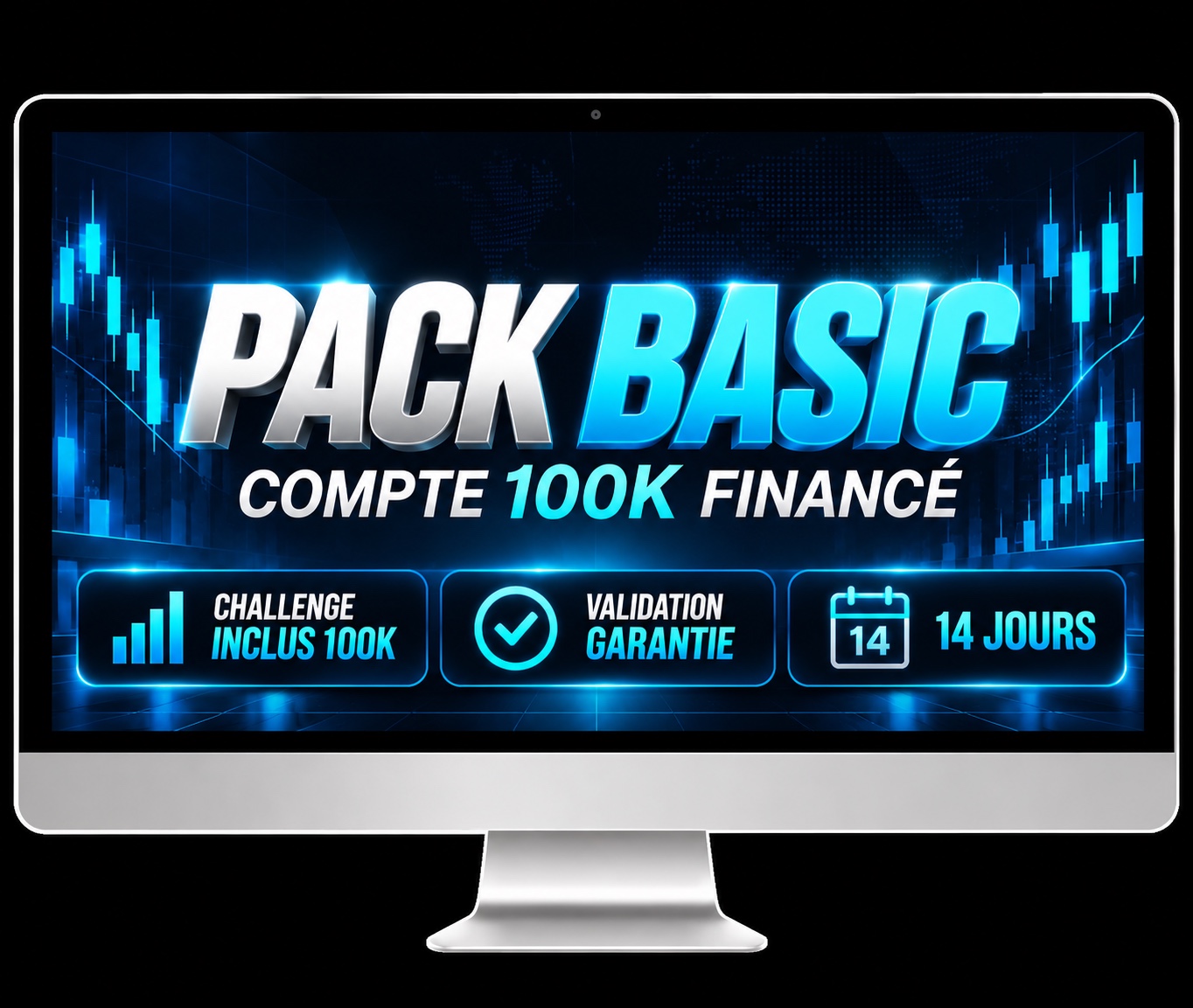
| Basic | 990 € | Complete beginner: fundamentals, risk management, first supervised trading plan |
| Gold | 1690 € | Trader who wants individual mentoring and a plan adapted to indices |
| Elite | 3490 € | Premium support: intensive challenge preparation and funded account tracking |
The index matters less than the method: the NAS100 program translates to the DAX40 or US500 with the same risk management instincts. Those focusing primarily on gold will find the detailed program in our article on XAUUSD prop firm training.
Conclusion: Method over volatility
The NAS100 rewards prepared traders and punishes improvisation. A prop firm index training program does not end your learning process: it provides you with a verifiable framework—schedules, setups, risk, journal—with which to measure your progress every week. Start by discovering our training programs and the detailed pages for the Basic pack, the Gold pack, and the Elite pack. And once your simulated fortnight is validated, move on to the next step: choosing your prop firm challenge.