Choosing a prop firm training program means comparing curricula, durations, and mentors. But the criterion that truly determines the quality of a purchase is often the last one looked at: the refund policy. A €1,690 program with no clear exit clause costs more than a €1,990 program that includes a cancellation window and catch-up support. In 2026, the prop firm training market has become professionalized, and guarantees have become a commercial argument in their own right—sometimes more marketing than contractual. This guide details what the proposed guarantees actually cover, the clauses that void them in practice, and the questions to send in writing before making any payment.
Why the guarantee matters more than the listed price
A prop firm training program is not a finished product that you install; it is a journey that requires several weeks, challenge capital to commit afterward, and discipline to maintain. Three risks accumulate at the time of payment: the program does not match the advertised level, the pace does not fit your schedule, or the content does not prepare you for the actual constraints of a firm (daily drawdown, news trading rules, HFT prohibition). A serious guarantee covers at least the first risk: the risk of suitability.
The classic trap is comparing only the amounts. A €990 training program with no exit option and no post-purchase support can end up costing more than a €1,690 package that includes sessions to correct your trading plan. The right approach: think in terms of total cost, guarantee included.
The five types of guarantees actually seen in 2026
Behind the phrase "satisfied or refunded," prop firm training programs actually offer five families of guarantees, which differ significantly in what they protect.
| Type of guarantee | What it covers | What it does not cover | Point to verify |
|---|---|---|---|
| Satisfied or refunded (14 or 30 days) | Pure and simple withdrawal, without justification | Content already consumed beyond a threshold (often 20 to 30%) | The calculation method for the threshold and the refund timeline |
| "Funded or refunded" guarantee | Refund if you do not obtain a funded account | Failures linked to non-compliance with firm rules | Number of attempts included, duration, firm involved |
| Challenge performance guarantee | Coverage of a new challenge in case of failure | The cost of the challenge itself in most cases | What is refunded: the training, the challenge, or both |
| Catch-up session | Additional access to a module or coaching | Nothing financial | Number of catch-up sessions and eligibility conditions |
| Post-training support | Follow-up after the end of the course | Nothing financial, but reduces the risk of dropout | Actual duration of support and channel (video call, messaging, group) |
A solid training program generally combines two of these guarantees: a withdrawal window at the beginning, followed by a catch-up or follow-up mechanism later. A program that offers only one, and only a financial one, deserves an examination of its general terms and conditions before any payment is made.
Clauses that void a guarantee in practice
Most disputes do not concern the absence of a guarantee, but rather its scope. Four clauses appear systematically and deserve to be read word for word.
1. The consumed content threshold
The "satisfied or refunded" guarantee often expires as soon as a percentage of the course has been viewed. A 20% threshold on an eight-week program can be reached in just a few days. If you want to test it seriously before deciding, verify that the threshold leaves enough time to attend at least two live sessions.
2. The "Active Participation" Requirement
Some results guarantees require a minimum number of sessions attended, assignments submitted, or trades logged. This is legitimate, but it means that the refund depends on your diligence, not just the result. Ask for the specific details: number of sessions, attendance rate, and the format of acceptable proof.
3. Exclusion of Firm Decisions
Failure of a challenge due to a rule violation (trade lasting less than sixty seconds, position opened during a major news event, exceeding the daily drawdown) is almost always excluded from results guarantees. This is consistent: the training program cannot be held responsible for the firm's decisions or your own. However, the training should explain these rules in advance, which is a good indicator of professionalism.
4. Non-Refundable Fees
Application fees, access to a third-party platform, or subscriptions to a trading journal tool: these amounts are frequently withheld even in the event of a refund. On a €1,690 package, this can amount to several hundred euros.
What French Law Protects, and What It Doesn't
For professional distance learning purchased by an individual, the regulations generally provide for a fourteen-day cooling-off period, unless the execution of the contract has begun with your express agreement and your waiver of the right of withdrawal. In practice, immediate access to videos, validated by a checkbox at the time of payment, can reduce this period to zero. This is not an anomaly; it is the mechanism provided by law, and it explains why so many training programs offer instant access.
The practical consequence is simple: do not rely on the law to compensate for vague commercial terms. The law protects you regarding the framework, not the pedagogical quality. The commercial guarantee, however, is your true safety net. To delve deeper into this point, our analysis of the twelve warning signs of trading courses is a useful addition to this reading.
Comparing Guarantees by Budget
The three FundedTrader.fr packs differ less in terms of the quantity of content and more in the level of support, and therefore the nature of the risk covered.
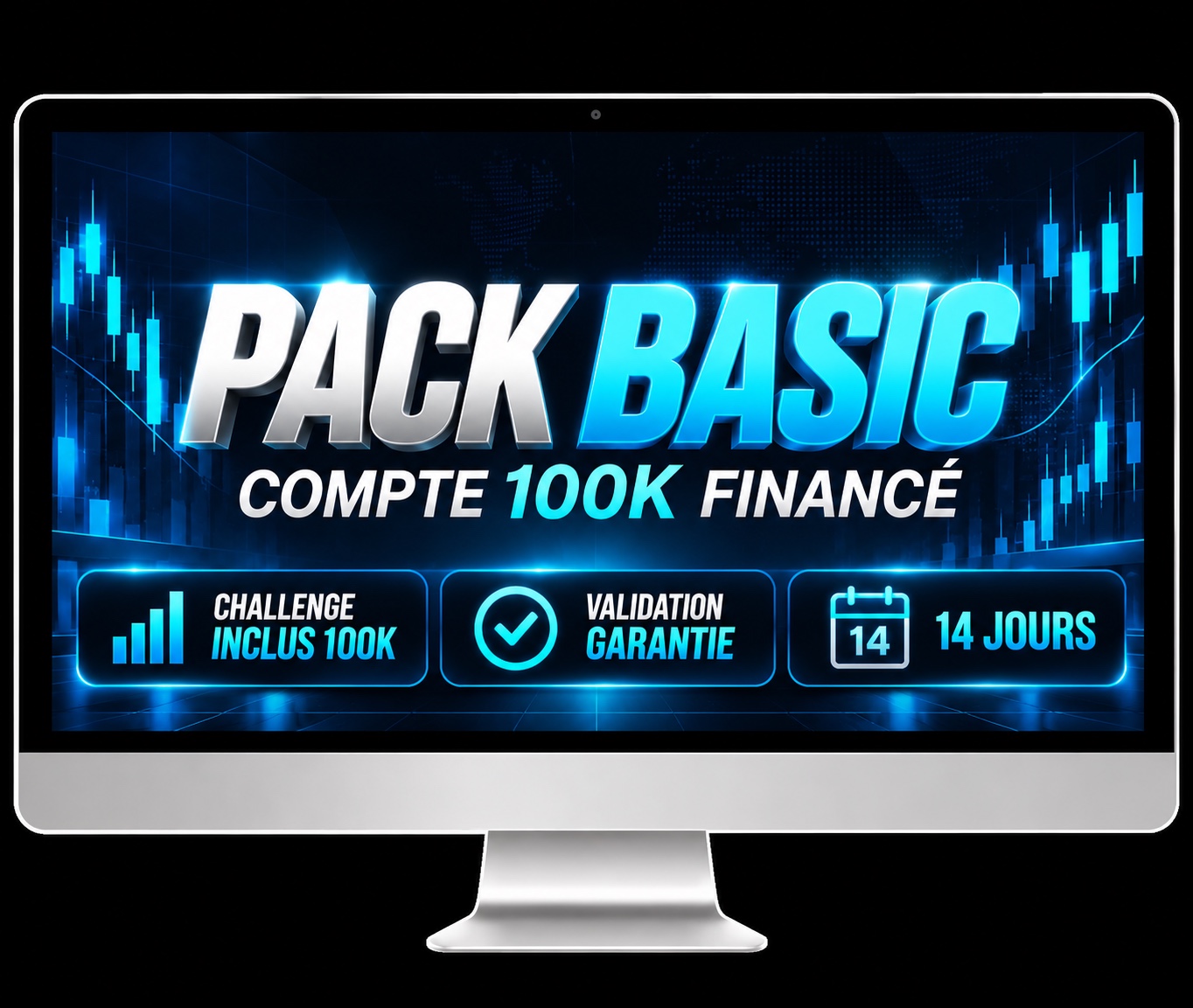
Basic Pack — €990
The Basic pack focuses on autonomy: structured curriculum, written materials, access to fundamental modules. The primary risk is isolation, not content quality. This format is suited to a trader who already has a plan and is looking for a clear prop firm validation method.
Gold Pack — €1,690
The Gold pack adds live sessions and progress tracking. This is the most common format for a serious beginner: you are mainly paying for feedback, i.e., external review of your plan and risk management.
Elite Pack — €3,490
The Elite pack corresponds to premium support, with personalized guidance. At this price point, the question of the guarantee becomes central: it is legitimate to demand a written framework, a schedule, and a clear catch-up mechanism.
To place these amounts within the full cost of a path toward funding, our article on how much a prop firm course really costs details the budget for challenges, tools, and time invested.
The eight questions to send in writing before paying
A serious trainer will answer these questions directly, and in writing. A trainer who dodges them is saving you time.
- What is the exact scope of the guarantee, as a percentage of content consumed?
- What is the stated refund timeline, in business days?
- What fees remain my responsibility in the event of a cancellation?
- Does the performance guarantee cover the training, the challenge, or both?
- How many attempts or retakes are included?
- What attendance requirements are necessary to remain eligible?
- How long does post-training support last, and through which channel?
- Can I obtain the terms and conditions of sale before payment?
A verbal response is worth nothing in the event of a disagreement. Ask for an email, and keep it.
Test the program before taking out your credit card
The best protection is to reduce uncertainty upfront. There are two levers: the free resources published by the trainers themselves, and trial formats. Firms like FTMO, Topstep, or FundingPips offer free academies, and a trainer's public content reveals their teaching style better than a sales page. Our selection of free resources for starting out in a prop firm allows you to form an opinion on a teaching style before committing a budget.
The choice between free and paid is not just about price: it comes down to structure and external feedback, as explained in our free vs. paid training comparison. And if you are still hesitant about the format, the Gold pack remains the most common compromise between cost and support.
Five-point decision checklist
- Terms and conditions are available before payment, and the scope of the guarantee is quantified therein.
- The threshold for consumed content allows enough time to attend two live sessions.
- Non-refundable fees are explicitly stated.
- The program explains firm rules (drawdown, news, HFT) before the challenge.
- A support system is in place after the course ends.
With all five boxes checked, the question of a refund becomes an administrative detail rather than a gamble.
Key takeaways
A refund guarantee is never a sufficient reason to buy, but its absence is a strong warning sign. The prop firm training programs that last are those that document their conditions, limit vague exclusions, and take responsibility for post-sale support. Before paying, ask for the terms and conditions, send the eight questions, and compare what each pack actually includes for the same budget.
Discover our training courses to compare the three paths and their conditions. And when your plan is ready, the next step takes place in the field: discover our trading challenges to put your method to the test under real conditions.