Prop firm training for students: balancing studies and trading in 2026
Being a student and aiming for a funded account is a double bet: learning a market profession alongside an already busy curriculum, with a tight budget and an unpredictable schedule. The good news: prop firms require neither a degree nor professional experience, only consistency. Even better: the skills of a good student, rigour, learning ability, deadline management, are exactly those of a trader who passes a challenge. What you need is a method adapted to your situation, not a schedule copied from a full-time employee. Here is how to choose your prop firm training as a student, organise your time slots around classes and aim for your first challenge without sacrificing your studies.
Why students are a special profile for prop firms
Prop firms have a simple model: they fund traders who prove their consistency, in exchange for a share of the profits. No serious firm will ask you for a CV or a degree: your validation account speaks for you. For a student, this is a rare opportunity, a sector where age and status count for nothing compared with performance.
But the student profile has three constraints that an evening employee does not have. First the budget: between housing, transport and student life, putting €1,000 into training or a challenge requires a real trade-off. Then fragmented availability: classes, exams, internships, your week looks like a puzzle. Finally the horizon: a student has time on their side, which allows building over 6 to 12 months where others want immediate results. Training designed for this specific constraint changes everything.
The real student challenge: time, not money
Contrary to popular belief, budget is not a student's first obstacle. The real problem is the structure of time: the active markets (London open, London-New York overlap) often fall in the middle of the morning or early afternoon, during lectures.
Analyse in the evening, execute at the right time slots
The solution is not to trade more, but to separate learning from execution. Evenings are for analysis: chart reviews, backtests, trading journal, videos from your training. The slots between two classes or the lunch break are for executing plans already written down, in 20 to 40 minutes. A student can perfectly well trade one to two useful hours a day if three quarters of that time is analysis prepared in advance, exactly the principle of our 90-day plan to learn trading for free, transposed to the university rhythm.
Exam periods: cut, don't catch up
The rule funded students follow: during exams, you cut live trading. A prop firm challenge plays out over weeks, not days; going ten days without trading does not kill an account, but exam stress does. Holiday periods, on the other hand, are accelerators: two weeks of July devoted to an intensive trading internship are worth a month of evening sessions.
Prop firm training for students: the real budget
Budgeting your training as a student means costing out everything. Here are the main items, with the possible savings:
| Item | Realistic range | Student lever |
|---|---|---|
| Trading training (complete pack) | €990 to €3,490 | Spread over the year, choose the pack suited to your level |
| Unlimited demo account | €0 | Essential for the first 3 months |
| First prop firm challenge | €50 to €300 depending on size | Start on €5,000 to €10,000, no more |
| Tools (VPS, indicators, journals) | €0 to €30/month | Almost everything exists for free |
| Error margin (2nd challenge) | €50 to €300 | Plan for it from the start, not after failing |
Over a year, a careful student who starts for free, trains seriously and then attempts two challenges counts about €1,500 to €2,500 all inclusive, training included. That is the same order of magnitude as a year's leisure budget, but with a professional goal behind it. For the detailed version item by item, our article on the complete budget of prop firm training breaks down every line.
Choosing your training as a student
Facing the offers, three criteria matter more than anything for a student. The first is flexibility: 100% online training, available on replay, beats a programme with mandatory live sessions at fixed times. The second is support: as a beginner, being able to ask a trainer or a community your questions avoids months of mistakes. The third is progression: a curriculum that goes from the basics (reading charts, risk management) up to the challenge, not a signals package.
Which pack to choose according to your level
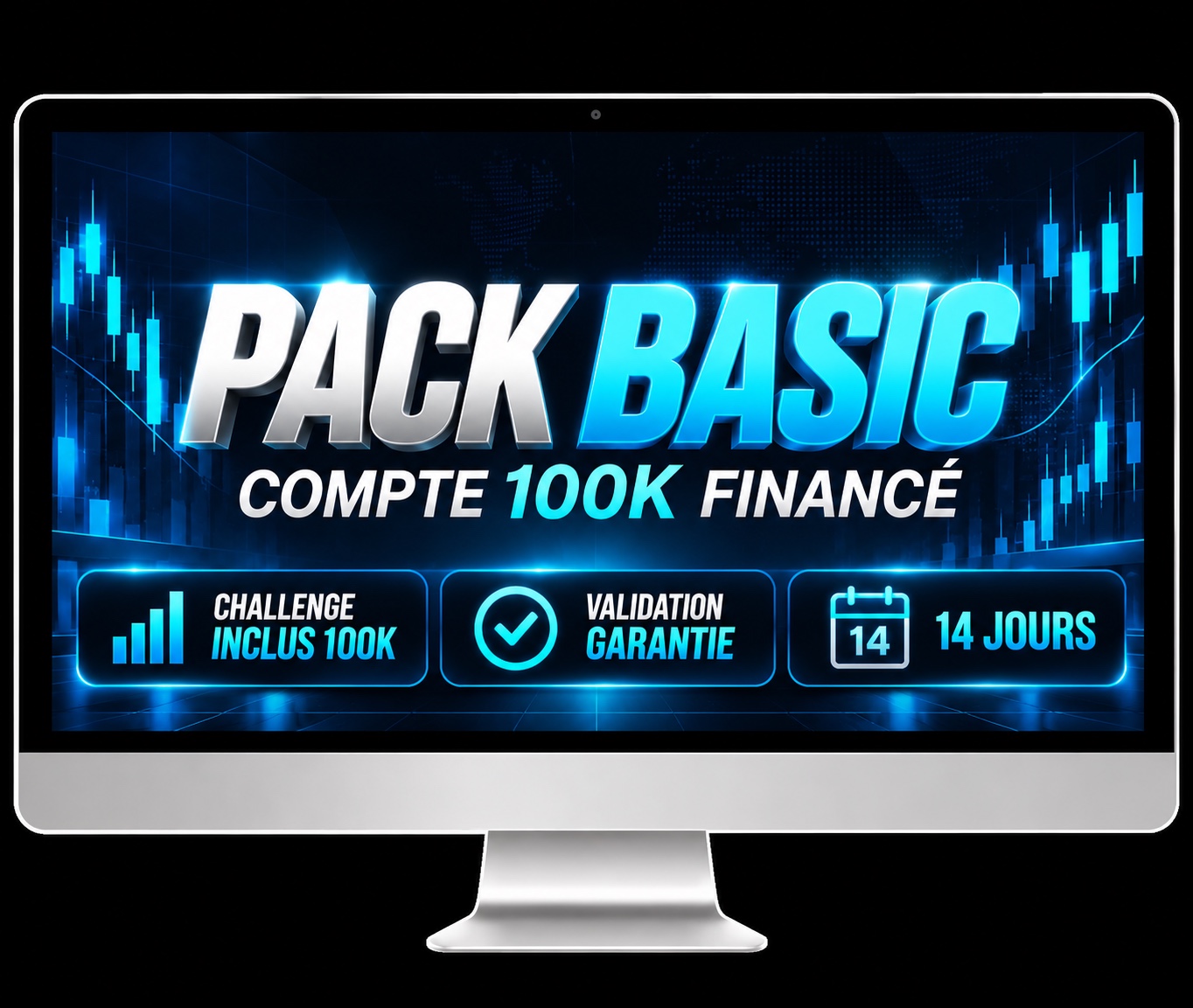
The Basic Pack (€990) is the logical entry point if you are starting from zero: fundamentals, risk management and preparation for your first challenge, without a heavy commitment. The Gold Pack (€1,690) adds support and feedback on your trades, relevant as soon as you trade demo regularly and want an outside eye on your journal. The Elite Pack (€3,490) targets intensive premium support, better suited to the student who is already validated or ready to treat trading as a true specialisation year. In all cases, explore our training courses and compare before choosing.
Free first, paid later
The winning sequence for a student budget: three months of free resources (guides, prop firm webinars, our training articles) to verify your consistency, then investing in a pack once you know you will keep up the pace. Reversing this order is the first cause of dropping out.
From training to the first challenge: the roadmap
- Months 1 to 2, learn on demo: follow the pack programme, keep a journal from the very first trade, target 30 journaled trades.
- Month 3, structure: one single strategy, written down, with fixed entry, exit and risk rules.
- Months 4 to 5, prove consistency: 8 weeks of demo without a significant negative week, at 3 to 5 trades per week.
- Month 6, launch the challenge: small size (€5,000 to €10,000), with the execution schedule around classes already set.
- After the challenge, iterate: funded or not, redo the analysis with your training notes.
This path echoes the method of the evening and weekend plan for employees: whatever your status, it is the weekly structure that decides the result.
The 5 traps specific to students
- Trading between two classes on your phone: without prior analysis, these are bets, not trades. Keep the mobile for monitoring, not deciding.
- Funding the challenge with rent money or your student grant: only commit money you can lose twice.
- Choosing training through TikTok hype: a trainer showing profit screenshots without a written method is not a programme.
- Sacrificing your studies: a validated semester is a safety net; trading can wait for your holidays, not the other way round.
- Aiming for a €100,000 account on the first attempt: challenge fees climb with size; start small, prove yourself, scale up.
Conclusion: your student years are an advantage
As a student, you do not have less time than other candidates: you have different time. Well-chosen prop firm training turns that constraint into a method, fragmented analysis in the evening, short execution at the right time slots, breaks during exams and acceleration during the holidays. With a controlled budget (from €990 to €3,490 depending on the pack) and a 6-month roadmap, your first challenge is not a question of luck but of discipline.
Ready to move from theory to your first funded account? Choose your prop firm training or directly compare the available challenges to calibrate your first attempt.