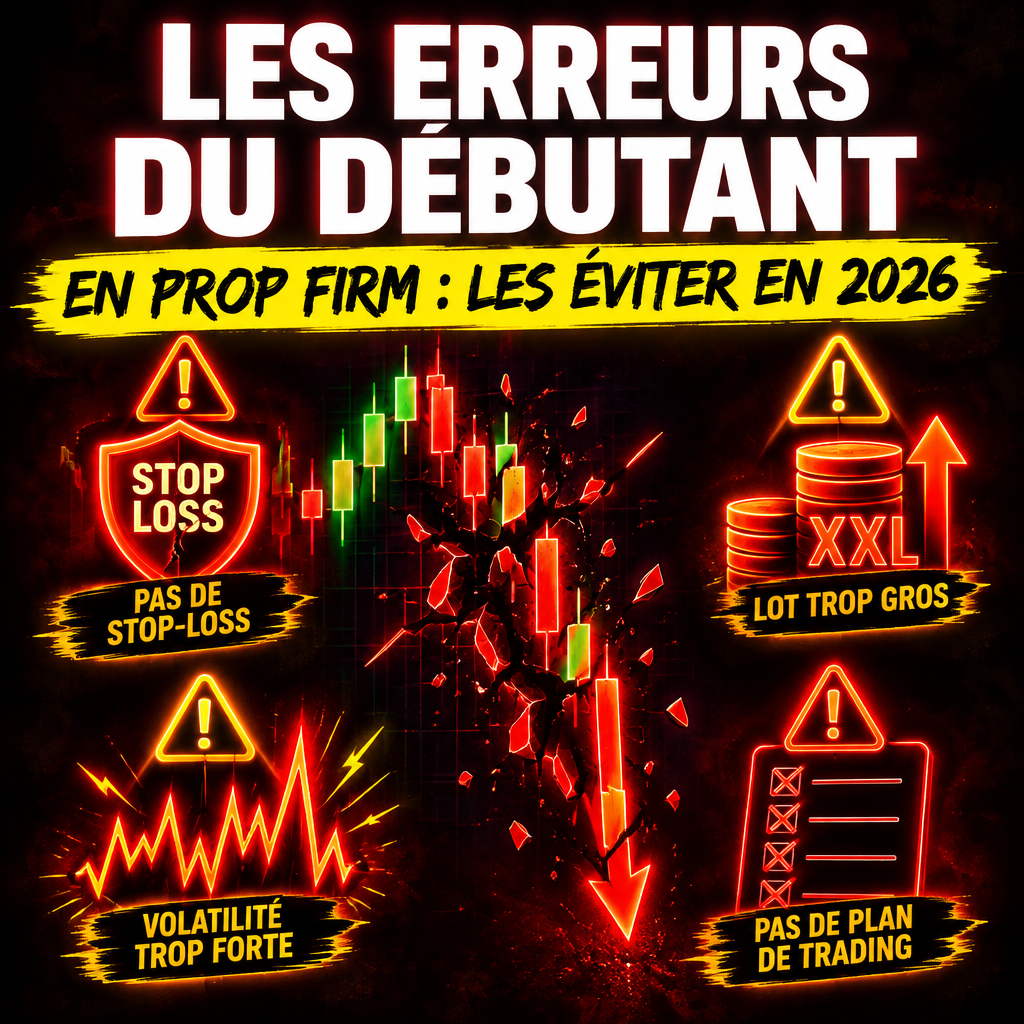
The vast majority of traders who fail a prop firm challenge do not lose because of the market: they lose because of perfectly identifiable and correctable beginner mistakes. Overtrading after a loss, oversized positions, confusion between balance and equity drawdown, lack of a written plan... These mistakes cost an average of several challenges before the lesson finally sinks in, often after $50 to $300 entry fees have gone up in smoke.
A structured prop firm training course is specifically designed to correct these errors BEFORE you pay for your first challenge. In this article, we review the 7 most costly beginner mistakes, their direct consequences during a challenge, and what organized guidance concretely changes in each case.
Why do beginners fail challenges so often?
The statistics published by the prop firms themselves are undeniable: depending on the firm and the cohorts, between 80% and 95% of participants fail the evaluation phase. This figure is scary, but it is misleading: it lumps together prepared traders and traders who discover drawdown on the day their account is opened.
When analyzing the causes of failure, the market itself is far down the list. At the top, we consistently find the same behaviors: revenge trading, excessive risk, lack of a plan, and poor account choice. These are exactly the points that a serious prop firm training course works on. If you are interested in the topic, our article on the 5 mistakes that cause a prop firm challenge failure details the mechanism behind each typical failure.
The difference between a self-taught trader and an accompanied trader is therefore not the quantity of information: it is the moment the error is corrected. On your own, you correct it after paying for the challenge. With guidance, you correct it before.
The 7 beginner mistakes that a prop firm training course corrects
Mistake 1: trading without a written trading plan
The beginner has a "market idea" in their head, not a plan. The result: every trade is an improvisation, and the consistency required to pass a challenge (8% profit over two phases, often with no time limit) becomes impossible.
A prop firm training course forces you to formalize: instrument, timeframe, entry criteria, invalidation, position sizing, and trading hours. The plan is not a decorative document: it is what allows you to hold up for 30 to 60 days of disciplined trading without drifting.
Mistake 2: oversizing positions after a losing streak
This is the classic beginner's mistake: doubling down to "make it back." In a real account, it drains the deposit. In a challenge, it triggers the maximum daily loss in two trades, and failure is immediate.
Guidance corrects this reflex by working on risk per trade (0.5% to 1% maximum) and by the mental stop rule: after two consecutive losses, you reduce the size; you never increase it. This simple protocol, repeated until it becomes automatic, is enough to eliminate the majority of premature failures.
Mistake 3: confusing balance drawdown with equity drawdown
Many firms calculate the maximum drawdown on equity, including open positions. The beginner looks at their balance, thinks they are safe, and gets disqualified by a floating position that was in profit but turned against them.
A prop firm training course addresses this point technically: reading drawdown in real-time, the impact of floating positions, and choosing firms whose drawdown rules match your style (trailing or not, balance or equity). Ignoring this subtlety is like playing a game without knowing the rules.
Mistake 4: changing strategies every two weeks
The beginner tests a strategy, suffers three losses, watches a YouTube video, ch
approach angle. This cycle prevents any statistical validation: a strategy needs a sample of 50 to 100 trades to be judged.The role of training is twofold: to help you choose ONE strategy suited to your available time and temperament, and then to prevent you from changing it as long as your trading journal does not show a structural flaw. It is a work of patience that the self-taught trader has no guardrails to maintain.
Error 5: Not keeping a trading journal
Without a journal, it is impossible to know if your losses come from the strategy, the execution, or your discipline. The beginner "knows" they traded well; the numbers often say the opposite.
The most serious training programs impose a journal format and, above all, a regular review: each week, trades are analyzed, errors are categorized, and a single area for improvement is set for the following week. This regular feedback is the most effective engine for progress in trading, and it is exactly what a beginner on their own never provides for themselves.
Error 6: Aiming for profit targets instead of consistency
In a challenge, the beginner watches the equity curve climb toward the 8% target and takes increasing risks as they approach the goal, or panics as they approach the daily loss limit. The result is management guided by emotion, not by a plan.
Prop firm training reframes the objective: do not aim for profit, aim for the consistency that produces profit. Concretely: aim for low volatility in results, a few units of risk per week, and let compounding do the rest. Traders who pass their challenges are almost always the most "boring" ones in their journals, not the most spectacular.
Error 7: Choosing the wrong account and the wrong firm
The final error, often underestimated: a $100,000 account with a 5% daily loss limit seems comfortable, but the size that matters is the one your psychology can handle. Choosing an account that is too large, a firm whose rules (news trading, overnight, consistency rule) contradict your style, or non-refundable fees when your budget is tight, means losing before you even begin.
This is a point where mentorship adds real value: choosing the account size, firm, and rules adapted to YOUR profile, with a challenge budget integrated into your plan from the very start.
Summary table: the 7 errors and what training corrects
| Beginner error | Direct consequence in a challenge | What training corrects |
|---|---|---|
| No written plan | Improvisation, inconsistency over 30-60 days | Formalized and tested trading plan |
| Over-sizing after losses | Max daily loss hit in 2 trades | Risk protocol of 0.5-1% per trade |
| Confusion between balance / equity | Disqualification due to floating drawdown | Understanding drawdown and choosing a suitable firm |
| Constantly changing strategy | No statistical validation possible | Commitment to one strategy + data-driven review |
| No journal | Errors remain invisible, no progress | Required journal + weekly feedback |
| Aiming for profit targets | Increasing emotional risk, blow-up | Consistency and volatility-based goals |
| Wrong account / firm | Structural failure before the first trade | Selection of account and firm based on profile |
What free resources do not correct
Let's be honest: all the information necessary to understand these errors exists for free, including on this site (see our selection of 15 free resources for beginners). The beginner's problem is not access to information, it is triple-fold: the lack of structure, the lack of feedback on THEIR trades of his OWN, and the lack of accountability to stay the course when motivation wanes.
This is precisely the debate we detail in free vs. paid training: which one to choose: free content is excellent for understanding, while paid training is justified when it comes to correcting your specific mistakes with an outside perspective over a long period.
Which pack to choose based on your dominant mistakes
At Fundedtrader.fr, three packages correspond to three error profiles:
- Basic Pack (990 €): to correct methodological errors (trading plan, journal, risk protocol) with a structured, self-paced program. Ideal if your errors are primarily structural.
- Gold Pack (1 690 €): adds support and review of your trades. This format corrects execution and discipline errors the fastest, because an outside eye sees what you will never see on your own.
- Elite Pack (3 490 €): premium support with custom challenge preparation, assisted firm and account selection, and follow-up until validation. Designed for those who want to address the 7 errors while preparing to go live.
Discover our training courses to compare the three packages in detail.
How to verify your progress before launching a challenge
Once the mistakes are identified, the method is the same for everyone: 90 days of structured practice, in a demo or on a small real account, with a weekly journal. Our guide for starting prop firm training offers a step-by-step path, and the complete week-by-week program details the skill progression up to the funded account.
The criteria for success is simple: you are ready to launch a challenge the day your journal shows 8 consecutive weeks without any of the 7 errors in this table. Not before.
Conclusion: correct before you pay
Every failed challenge costs between 50 and 300 €. Multiplied by the three to five attempts most beginners pay for before changing their approach, the bill for "learning on the job" quickly exceeds the cost of training, not to mention the time lost. Correcting the 7 beginner mistakes beforehand, with a plan, a journal, and an outside eye, is mathematically the cheapest path to a funded account.
When your 8 weeks of journaling are clean, take the next step: compare programs and choose your challenge on our trading challenge comparison page.