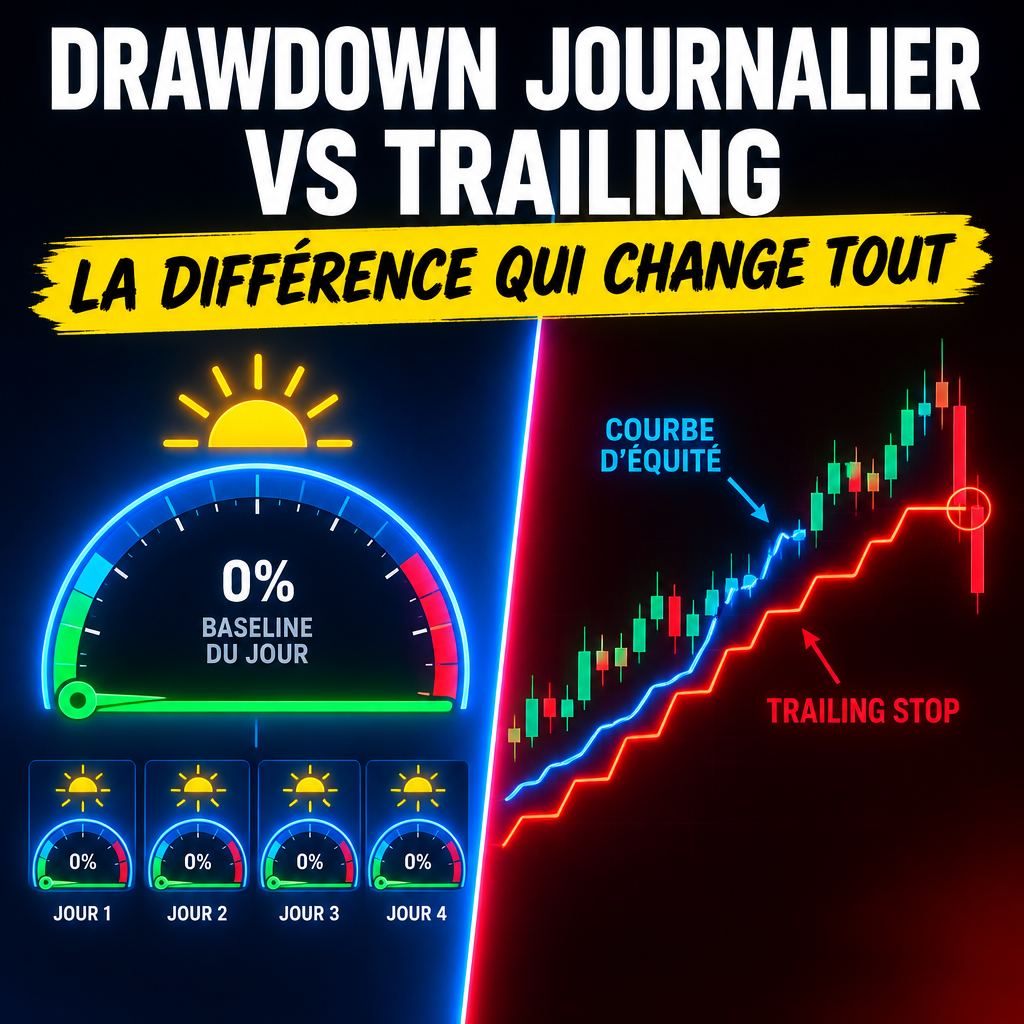
A trick question asked by two-thirds of traders preparing for a challenge is: "Is the drawdown daily or overall?" The answer: both. Confusing daily drawdown with trailing drawdown is one of the leading causes of failure in prop firms. An internal study of failed evaluations shows that a major portion of violation clauses relates to non-compliance with drawdown rules, often due to a misunderstanding of how they are calculated. Here is a breakdown of both mechanisms, with numerical examples and the method to never confuse them again.
Daily drawdown: your 24-hour guardrail
The daily drawdown is the maximum loss allowed during a single trading day. In most 2026 CFD challenges, it is set at 5% of the initial balance during the challenge phase and 4% to 5% during the verification phase. A crucial point: it is calculated from the highest value of the day (equity or balance, depending on the firm), and it resets every day at midnight (server time, often CE(S)T).
In concrete terms, on a $100,000 account with a 5% daily drawdown: if your equity climbs to $101,200 in the morning, your floor for the day is no longer $95,000 but $96,140 ($101,200 − 5% of $101,200). This is the classic trap: a winning trade in the morning tightens your margin for error in the afternoon. Three trades at -1.5% each from that high point, and you are disqualified even though your balance still shows +0.7%.
The good news: the daily drawdown resets to zero the following day. One bad day never ruins a challenge on its own. It is a safeguard designed to enforce daily discipline, not to trap a healthy account.
Trailing drawdown: the enemy that tracks your gains
The trailing drawdown never resets. It follows the highest point reached by your equity since the start of the challenge, whether that is the balance or closed equity, depending on the firm. The current 2026 standard: 10% in phase 1, 5% in phase 2, sometimes 6% to 8% on instant accounts, and 4% to 5% on funded futures accounts.
Example: $100,000 account, 10% trailing. You have a string of good days and your equity hits $108,000. Your floor then rises to $98,000—you can lose $10,000 from the peak, but you can only fall $2,000 below your initial balance at the maximum reached... but more importantly, this floor will never go back down. If you fall back to $100,500 after hitting $108,000, your remaining margin is visually only about $1,500 ($98,000 + margin), and the slightest impulsive trade will take you out of the game.
The danger of the trailing drawdown is as much psychological as it is mathematical: the more you win, the more your safety net moves upward, not downward. A trader who is +9% on their challenge with a 10% trailing often only has a 1% to 2% cushion in apparent downside compared to the balance, even though they thought they had "plenty of margin." A textbook case is that of futures firms, where trailing is the dominant rule: our dedicated analysis "E8 Markets: Mastering the Trailing Drawdown" details this mechanism at a benchmark player in the segment.
Comparison table: the two drawdowns side-by-side
Calculation: the daily starts from the day's high; the trailing starts from the all-time high. Reset: the daily resets to zero each night; the trailing never resets. Typical value: 4% to 5% vs. 10% (phase 1). Main danger: the daily punishes intraday overtrading (multiple cumulative losses in the same day); the trailing punishes "round-tripping" (giving back a large portion of gains). Exposed profile: scalpers with a high volume of trades are most sensitive to the daily; swing traders who take partial profits and then let the account breathe are most sensitive to the trailing.
The anti-drawdown method in 4 rules
1. Calculate your two floors every morning
Before taking any position, write down in black and white: the daily floor (today's equity or initial balance, depending on the rules) and the current trailing floor (all-time high − applicable trailing). These two figures define your actual available risk, which is very different from the simple "I have X% left before the overall drawdown" that beginners read. A two-column spreadsheet is enough, or a well-maintained trading journal as described in our "weekly performance review" method.
2. Size your risk based on the nearest floor
Risk per trade must always be calculated in relation to the most restrictive floor, not in relation to the displayed balance. Our guide "how much to risk per trade in a challenge" recommends 0.5% to 1% maximum: at this pace, it takes 5 to 10 consecutive losses to hit a 5% daily drawdown — a survivable "worst-case" scenario, unlike a 3% risk strategy which is unforgiving.
3. Never let an unsecured profit approach the trailing
When your equity hits +7% or +8% toward the +10% goal, secure partial profits before attacking the final points. A challenge is finished by scaling down, not by scaling up: this is exactly the opposite of a trader's intuition. Typical errors at this stage are documented in "the 5 errors that cause a prop firm challenge to fail."
4. Check your firm's specific calculation variant
Not all firms calculate drawdown based on real-time equity: some use the closed balance (which is forgiving of open intraday drawdowns), while others use floating equity (open positions count). This single variable radically changes your margin on a trade that goes wrong. Before paying for a challenge, read the "drawdown" section of the rules and simulate two scenarios: a closed loss and a floating loss. Our prop firm comparison tool allows you to filter firms based on the type and level of drawdown imposed.
Drawdown and minimum days: save time, not margin
One last point that is often ignored: the majority of 2026 challenges impose a minimum number of trading days (often 3 to 5 days per phase). This counter advances even on days without trades... depending on the firm: some require at least one trade to validate the day. Combine this parameter with the drawdown: it is better to aim for +0.3% per day for 12 days than +8% in 2 days followed by a forced unfreeze. Consistency is also a weapon against drawdown, as shown in our analysis of the prop firm challenge success rate.
Conclusion: Draw your two red lines before opening a single trade
Daily drawdown and trailing drawdown do not protect against the same risk: one monitors your day, the other monitors your peak. The trader who gets funded in 2026 is the one who knows their two exact floors every morning and sizes each position based on the more restrictive of the two. Once these habits are ingrained, risk management stops being a burden and becomes your competitive advantage. And to move on to the next phase with confidence, follow the method detailed in "After validation: the 7 steps of the funded account."
Secure your validation before you begin. Fundedtrader.fr supports traders throughout the duration of the challenge: risk plans calibrated to your drawdowns, daily tracking, and preparation for moving to a funded account.
The specific case of futures firms and instant funding
With futures prop firms, the trailing is often calculated on the end-of-day equity rather than in real-time: the intraday margin is wider, but the overall ceiling is lower. On instant CFD accounts, the 2026 trend is toward fixed drawdown: the floor does not move, in exchange for no trailing and a tighter overall ceiling. These variations change everything regarding position sizing and confirm the golden rule: your firm's rulebook is worth more than any generic tutorial. To compare these parameters before purchasing a challenge, filter firms on our prop firm comparator and re-read the drawdown section of the contract.